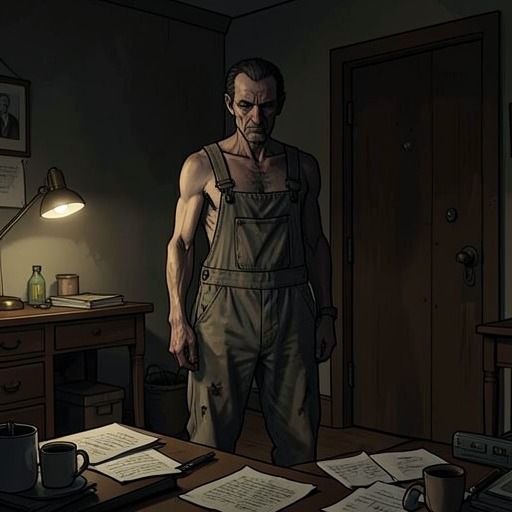
Selden's escape and hiding on Dartmoor
The Hound of the BaskervillesSelden's escape and hiding on Dartmoor turns the moor into both refuge and pursuit ground. His concealment depends on the secret aid of his sister, Eliza Barrymore, and her husband, but the discovery of their signals brings Dr. Watson and Sir Henry Baskerville into a nighttime chase that fails to recapture him. The episode also clarifies that the Barrymores' furtive activity was an act of family loyalty, not a plot against Sir Henry.
Escape and the Moor as Refuge
As Dr. Watson and Sir Henry travel toward Baskerville Hall, their driver, Perkins, reports that a convict has escaped from Princetown Prison and has been at large for three days. Warders are watching roads and stations without finding him. Local farmers fear the fugitive more than they value the five-pound reward for information, because they understand him as a dangerous man. When asked who he is, Perkins identifies him as Selden, the Notting Hill murderer.
Dr. Watson recalls that the crime had attracted Sherlock Holmes's interest because of its ferocity and that doubts about Selden's sanity had led to the commutation of his death sentence. This information shapes the travelers' expectations before they learn where Selden is hiding: the fugitive is not merely a man avoiding capture, but someone the surrounding community has reason to fear. The moor, where he has found shelter, becomes a place in which the threat feels close even before he is seen.
Selden has not simply disappeared into the wilderness. He has taken refuge on the moor while remaining within reach of people who can provide for him. The arrangement is precarious: concealment depends on keeping his location secret and maintaining a means of contact with the house. Those practical needs eventually expose the human network that makes his hiding possible.
The Barrymores' Secret
The secret comes to light when Sir Henry and Dr. Watson connect the nighttime light at a window with a corresponding signal on the moor. In their confrontation with the Barrymores, Eliza explains that Selden is her younger brother. She accepts responsibility for the assistance, insisting that her husband acted at her request and out of concern for her. Her disclosure changes the meaning of the couple's nocturnal movements: they have been helping a fugitive, but their immediate motive was kinship rather than hostility toward Sir Henry.
Eliza describes a family history in which Selden was indulged as a boy and came to expect that he could do as he pleased. As he grew older, she says, he associated with bad companions and moved from one crime to another, bringing distress and disgrace to the family. She nevertheless remembers him as the little brother she had nursed and played with. Her account holds those two versions of him together: the notorious criminal feared by the community and the younger sibling to whom she feels bound.
When Selden arrived at the house, Eliza says, he was exhausted and hungry, with warders close behind him. The couple took him in, fed him, and cared for him. After Sir Henry's arrival, Selden judged the moor safer than the house while the search continued. The Barrymores then used a light in the window every second night to check whether he remained nearby. If he answered with a light of his own, Barrymore carried bread and meat out to him. Their routine balanced the desire for Selden to leave with their unwillingness to abandon him while he remained close by.
Discovery and Failed Pursuit
Once the explanation is known, Sir Henry reasons that Selden cannot be far from the place where Barrymore has carried food. He decides to go out and seize the fugitive. Dr. Watson agrees, viewing the pursuit as a duty to the community: Selden's record makes it possible that others could be endangered if he remains at large. Their decision is not presented as a response to a threat against them personally; the immediate aim is to return a dangerous escaped convict to custody.
Near the moor signal, Dr. Watson and Sir Henry see Selden at the rocks by the candle. He notices them, appears suspicious, and reacts before they can close in. He curses them, throws a rock that strikes a boulder, and runs. The moon emerges as they follow, allowing them to see him moving quickly over the stones and away down the slope. Dr. Watson has brought a revolver for self-defense, but does not shoot at a fleeing, unarmed man.
The two pursuers run after Selden, but cannot catch him. They watch him grow distant among the boulders until he is only a small figure on a far hill, then stop, exhausted, and abandon the chase. The practical result is a second escape: the discovery of the Barrymores' method breaks the secrecy around the hiding place, but does not put Selden back in custody.
Aftermath and Narrative Significance
As Dr. Watson and Sir Henry turn back, Dr. Watson sees a separate figure standing on a granite tor against the moon. He judges the figure to be tall and thin and explicitly distinguishes him from Selden, who has disappeared elsewhere and is much shorter. The silhouette vanishes when Dr. Watson turns to alert Sir Henry. The encounter does not resolve the identity of the watcher, but it adds another unexplained presence to the same nighttime landscape in which the pursuit has just failed.
The episode therefore changes the reader's understanding on two levels. The light on the moor is explained as a family signal, and the Barrymores' secrecy is separated from any scheme against Sir Henry. At the same time, the fugitives' brief appearance and renewed escape leave the immediate danger unresolved. The chase supplies a concrete account of Selden's hiding and the means by which he is supported, while the distant figure on the tor keeps the moor's wider mystery open.